“Prove” your Manuscript

Proving bread

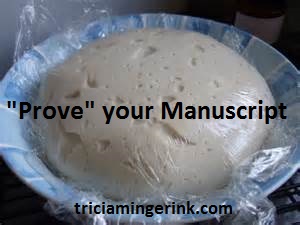
On a baking show I was watching recently, the contestants had to make a certain kind of bread. For the bread to turn out, they had to “prove” their dough, a professional baking term for letting the dough rise before baking.

And, being the writer I am, it reminded me of writing. As writers, we also need to “prove” our manuscripts. Once we finish assembling our ingredients of plot, character, theme, and setting into the dough of our first draft, we need to give our manuscript time to sit. If you try to edit right away, either you will be so in love with your words how they are that you won’t edit enough or you will be so wiped by the first draft that you’ll hate your words and be tempted to throw them all away.

Instead, be willing to give it time.

It is amazing the change of perspective that comes about by not touching a manuscript for a few weeks or a few months. Sometimes, I have a manuscript that I absolutely adore. When I take it out again, I start to see all the places that it isn’t actually as great as I thought it was. Sometimes, I have a manuscript that I toss into a drawer in frustration because it fought me every step of the way while drafting. When I take it out again, I see the places where it isn’t actually as bad as I thought. There might even be something worth saving in it.

Like proving bread, proving your manuscript takes patience. It is very tempting to take it out too early and start fiddling with it even though you know it needs to sit longer.

What about you? How much time do you give yourself between writing a first draft and editing it?

Goals for the New Year

Antique pen and inkwell

This is a time of year for looking back at the past year of goals and looking toward new goals. After the holidays punctuate the end of the year in celebration, its time to get back to business. Back to the grind and the hard work that it takes to achieve goals.

This past year, I wrote 3 books and edited 3 books. I sent out 11 query letters and received 11 rejections. I finally established a writing routine and stuck to it for over nine months. I started this blog. All goals checked off a list.

This year, I have a new list of goals. I’d like to write 4 books and edit 3 books. I’d like to improve this blog by making it more reader friendly. I have other goals that I can’t reveal quite yet, but they’re exciting.

The long list of goals can be overwhelming. Shoulders can sag under the weight of goals needing to be checked off lists upon lists. Even exciting goals can be wearisome if they seem too big.

But they needn’t be too big. Yes, I have goals, but I must ultimately bow to God’s will. His will for my life trumps all my goals.

I hope, as you set out on your goals, that you are sustained as you tackle them this year.

Looking forward into this new year of blogging, what would you as readers like to see in this blog? More book reviews? More posts on writing? Other things?

Christmas Book Giveaway – The Princess Spy

Congrats to DeVorah, winner of last week’s giveaway!

Now on to this week’s giveaway!

This week I’m giving away a copy of The Princess Spy, the newest release by Melanie Dickerson. My sister-in-law recommended her books to me, and I loved them. They are fairy tale remakes set in a historical, medieval setting. While they stick to the plot line of the fairy tales for the most part, they are not constricted by them like some remakes are. Her latest release, The Princess Spy, is based on the frog prince fairy tale. I won’t give away how she manages to pull that one off!

Back Cover (from Amazon):

Margaretha has always been a romantic, and hopes her newest suitor, Lord Claybrook, is destined to be her one true love. But then an injured man is brought to Hagenheim Castle, claiming to be an English lord who was attacked by Claybrook and left for dead. And only Margaretha—one of the few who speaks his language—understands the wild story.

Margaretha finds herself unable to pass Colin’s message along to her father, the duke, and convinces herself “Lord Colin” is just an addled stranger. Then Colin retrieves an heirloom she lost in a well, and asks her to spy on Claybrook as repayment. Margaretha knows she could never be a spy—not only is she unable to keep anything secret, she’s sure Colin is completely wrong about her potential betrothed. Though when Margaretha overhears Claybrook one day, she discovers her romantic notions may have been clouding her judgment about not only Colin but Claybrook as well. It is up to her to save her father and Hagenheim itself from Claybrook’s wicked plot.

 My Recommendation:
 As with all her books, Dickerson weaves a deft tale combining the fairy tale and her historical setting. The Christian themes in the book are given a light touch, but they are still present throughout the book. My favorite part about this book is the character of Margaretha. Unlike some of the female main characters in Dickerson’s other books, Margaretha is not a lady to wait around for someone to rescue her. She is strong without being too bold. Her character has a good balance that shows it is possible to be a strong woman while still relying on others for help.
If you’d like to win a copy of The Princess Spy, please follow the Rafflecopter link below:

Christmas Book Giveaway – Of the Persecuted

This year, I’ve stumbled across a number of Christian YA speculative fiction authors whose books are now among my favorites. To share these awesome books and celebrate Christmas, I’ll be giving away a new book each week until Christmas.

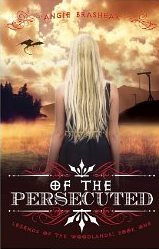
This week, I’m giving away a copy of Angie Brashear’s debut novel Of the Persecuted. This book’s title and cover art captured my attention the first time I saw it. Isn’t it stunning?

Of the Persecuted

 Back Cover Copy (from Amazon):
Laila Pennedy awaits death by hanging. For the Rendow Clan rules the Woodlands Region, aiming to slaughter the Faithful. And she deserves to die. But Lars Landre, the man destined to lead the Faithful out of persecution, has other plans hidden behind his rare and mysterious blue eyes. Rescue.

Following the daring escape, Laila seeks the path of a warrior and vows revenge against the Rendow Clan. She embarks on a dangerous journey with Lars, one in which they endeavor to reach the promised safety of a magical village, to train for battle, and to ultimately assure freedom for those with faith in the Maker.

Clashes of weapons and souls. Brutal loss of lives. Unrequited love. How in all the Woodlands will Laila survive?

My Recommendation

The characters and the story world in this book are unique. The first sentence grabbed me, and I couldn’t put the book down after that. While this is an indie published book, I didn’t find any editing issues. If I hadn’t known that this was an indie book, I wouldn’t have guessed it from the quality of the writing. Definitely a book to add to the shelf of favorites!

Personally, I go out of my way to support indie authors because I know they don’t have a publishing house behind them. What about you? When buying books, does it matter to you if they are indie or traditionally published?

Follow the Rafflecopter link below to enter to win an ebook or paperback copy of Of the Persecuted:

A Rafflecopter giveaway

Things to be Thankful For

Snoopy Thanksgiving

By now, you’ve probably read plenty of blog posts about thanksgiving and what people are thankful for. This is a good time of year to pause, look back, and reflect, and I guess this blog post isn’t going to be any different.

I could go on and on about how I’m thankful for nice clothes, a car, my family, etc. Those are all good things to be thankful for, and I am thankful for them. But here I would like to focus on five writing related things that I’m thankful for this year:

1. I’m thankful I wasn’t published this year. That sounds like a strange thing to be thankful for, but I’ve learned so much that I wouldn’t have learned if publication had come when I’d thought it would.

2. I’m thankful for the community of writers that I’ve discovered. This year, I commented on a few authors’ blogs and discovered that published writers are people too. I’m so thankful for Nadine Brandes, Angie Brashear, Gillian Bronte Adams, Jill Williamson, and other authors who have replied to my comments and encouraged me even though they have never met me in person. I still squeal in excitement when I see an author replied to one of my emails or my comments.

3. I’m thankful for my critique partners, whether they are ones I just met this year or friends I’ve had since high school. You all are so amazing, and I wouldn’t know how to write without your encouragement every step of the way.

4. I’m thankful for Go Teen Writers even though I’m no longer a teen writer. I’ve met so many unpublished, young authors through that blog, and I look forward to getting to know everyone there better next year. The community there is wonderful.

5. Finally, I’m thankful for you, my readers. I don’t even have a book published, but I have 49 likes on my Facebook page and 74 followers on my blog. I never would have thought that possible when I started this blog a few months ago! Thank you so much!

Confessions of a Recovering Perfectionist

The girl in the chair next to me peeks at her graded paper. “I got a B+.” She smiles, clearly happy with her grade.

“Great job!” I tell her. I know she must have worked hard on it. She’s a recovering drug addict struggling to put herself through college. I’m genuinely happy for her.

She turns in her seat. “What did you get?”

My stomach drops through my toes and seeps into the floor. Embarrassment heats my face. “Good enough.” I hedge, hoping that she’ll drop it.

She doesn’t. No one ever does. “It’s okay. You can tell me.”

More than anything, I don’t want to tell her. I’m too ashamed to admit my grade. I spent a grand total of fifteen minutes the night before it was due working on this paper. Hardly any time at all. But I can’t avoid her questions. I know from experience that she’ll ask until I tell her. That’s what everyone does. Finally I stare down at the desk and mumble, “I got an A.”

“That’s more than good enough! That’s great!” She grins at me.

I stare at her. I’d been expecting a snide remark. Another “Well, of course you got a good grade” in a sarcastic tone. Not this. Fresh shame burns my throat. She shouldn’t be congratulating me. “You spent more time on this paper than I did.”

Perhaps she recognizes the shame in my eyes, in my voice. Her tone softens. “It’s nothing to be ashamed of.”

Nothing to be ashamed of. Why had it taken an ex-drug addict at a public college to tell me what no one else had? My grades were nothing to be ashamed of. It’s okay to be smart. It’s okay to get a good grade with little effort.

In my junior high and high school, I’d heard teachers tell the class over and over again: I wish I could grade by effort. The C and B students put more effort than the A students. I would hunch in my chair. I was one of those bad A students, the one that gets an A on a test I didn’t study for, the one that spent a total of four hours studying for all of my exams and got an A on all of them while another student studied four hours for each exam and got Cs. If school was graded by effort, I would have gotten an F.

My grades shamed me. If I got an A with no effort, then was I really giving my best? Most of high school was so easy that I rarely felt challenged. Even when I did pour effort into a project or a paper, shame still clung to me. Had I really given my best effort? Had I actually worked hard? Surely that C student sitting next to me still worked harder than I did.

I demanded perfection from myself. A single wrong answer would gnaw at me for a week afterwards like an infection eating away at my stomach. I wasn’t worthy of my grades. I hadn’t earned them. I didn’t deserve them. Still the pursuit of perfection consumed much of my high school years. Perfection was king. At times, I felt like it determined my self-worth.

I hated admitting my grades to other students. Sometimes, I would even put my test straight into my folder without looking at it so I could answer truthfully that I hadn’t looked.

When my freshmen year of college rolled around, I enrolled in the Honor’s College. On my very first paper, I got a B. I stared at that red letter B for several minutes, shocked to see that grade on the top of one of my papers. I’d never gotten that low of a grade on a paper before.

And it felt wonderful.

For the first time in years, I could actually put effort into something. I worked hard on revisions and upped my grade to a B+. It was the best B+ I’d ever seen.

It was a long, slow road from that first B+ to the moment I realized I didn’t have to be perfect. My self-worth was not dependent on my grades or how much effort I put into them. I couldn’t earn perfection. Jesus had already earned perfection for me. His perfections cover me, earned me the words “Well done, thou good and faithful servant.” I don’t have to earn those words with my own pitiful efforts.

My gifts are given of God. I’m not to be ashamed of them. If I’ve been given the ability to take tests with little effort, then it would be wrong to put in more effort than necessary. I’d be wasting time and energy that I could spend elsewhere on my family. Friends. Neighbors. A person in my church in need. So many ways I could have used my time and energy in high school instead of the pursuit of perfection.

Writing is something that challenges me. Unlike history facts or science formulas, it is not something that can be memorized and declared learned. It is a constant learning and growing process. It is something that demands my hard work.

I don’t know what it is like to struggle in school. I don’t know the hardships that come with that. But I can understand the shame of hiding your grades. I can understand the fear that the teacher will call on you, fear so intense my shaking rattled my desk sometimes.

If someone from my high school reads this, then I am sorry if I ever made you ashamed of your grades. If I ever made you feel unworthy. It was not my intention. Most likely, I was too ashamed of my own grades to genuinely compliment you on yours.

I still struggle with perfectionism sometimes. If I mess up at work, I struggle to let go of the mistake and move on. It haunts the back of my brain, lingering, reminding me of all my failures. When I write, I have to write a really fast, messy drafts. If I stop to edit, then my perfectionism kicks in. I see all the mistakes, all the failures, and it clutters my mind so much that I can’t keep writing.

I have to keep my mind and heart focused on the Perfect One. I don’t have to be perfect because He is. I need to stop comparing myself to others and focus only on using my gifts in the way God would have me use them.
Why I Write Speculative Fiction

The-Chronicles-of-Narnia-The-Voyage-of-the-Dawn-Treader-the-chronicles-of-narnia-26731718-1920-1080


The Voyage of the Dawn Treader is my favorite book in the Chronicles of Narnia. I always loved the thrill of the sea voyage. I could feel the sea breeze on my face, hear the creaking of the ship’s timbers, and touch the cold spray on my face. I was always sad when it ended and Edmund and Lucy had to leave Narnia for the last time.

But Aslan tells them that he is in there world too. “But there I have another name. You must learn to know me by that name. This was the very reason why you were brought to Narnia, that by knowing me here for a little, you may know me better there.”
C.S. Lewis, The Voyage of the Dawn Treader

I knew Aslan’s other name. I knew C.S. Lewis referred to Jesus and I did know Jesus in our world.

As I began writing and telling my own stories, I realized Lewis was giving his reason for writing the entire Chronicles of Narnia in that quote. He hoped that his readers would get to know Christ a little in Narnia so that they could know Him better in their own lives.

This has become my goal as a writer. Like Lewis, I like to write speculative fiction, especially fantasy. Even if my fantasy doesn’t directly reference God or Christ, it still shows Christian morals and decision, much the same way that J.R.R. Tolkien showed Christ throughout The Lord of the Rings.

But my goal is always the same. I might be only showing a tiny aspect of Christ, a fragment of all the glories that He is, but my prayer is that God will use my small efforts to help readers know Him a little better.

Fantasy gives me the freedom to approach topics from different angles, much in the way that Lewis gave us different angles to Christ through Aslan. Historical fiction can only go so far. Fantasy can make us think about our faith differently.

What genre do you write? What is your goal in writing it?

Why Should Christians Write Fiction (Part Two)

blank-book-300x202

The fifth word in the Bible is created. 

We don’t talk about that a lot. We talk about the importance of the first 4 words: In the beginning God. But in that focus, we miss that God’s first action recorded in the Bible is the act of creation. The world we live in is the ultimate act of art, of imagination. God created the entire world as a beautiful piece of art for His own pleasure. The stars in the farthest reaches of space out of the sight, the sparkling fresh snow on a mountain top where no one but God will see it, the delicate flower that blooms and dies before any human comes across it…all of these beauties are enjoyed by God alone for His glory alone.

As humans, we have imagination. It is one of the things that separates us from the animals. When we create any art, we are mirroring God’s action of creation. We are projecting God’s glory back to Him. Art isn’t a waste of time. It is another way to give glory to God and show that glory to others.

As writers, we have a special kind of art. Words are a special part of God’s creating act since He created using speech, using words. He communicates to His people through the Bible, His Word. Jesus Himself is called the Word.

Few other types of art come as close to creating something out of nothing as writing. Writers take something as wispy as ideas and as intangible as words and uses them to build stories and worlds and characters (For more thoughts on this, check out this blog post).

When we write fiction, we are mirroring God’s work of creation. We are displaying the glory of God’s creation in our small and human work of creating. I think this is especially seen in writing speculative fiction stories. I could write more about this, but while I was brainstorming this post, Nadine Brandes wrote this beautiful post on this topic that sums it up much better than I can.

How do you mirror God’s act of creation in your writing?

Why Should Christians Write Fiction? (Part One)

The Power of Story

Sometimes when I tell people in Christian circles that I’m a writer, they smile at me and reply, “That’s good. We need more good articles.” Their faces go from interested to shocked when I calmly explain that I write books. Not doctrinal, nonfiction books, but fiction books. They don’t know how to react.

It is ironic how the same people that decry the lack of good literature for their children don’t do anything about it. Nor do they understand when anyone else does something about it. Writing fiction is somehow…lower. It isn’t the worthy calling that writing nonfiction is.

Except that this idea isn’t true. Fiction writers are just as necessary as nonfiction writers. Because the Story format is important to convey empathy and characters in a way nonfiction articles struggle to do.

Look at the Bible for example. We talk about Bible stories. Most of the Bible is written in a story format. Even books like the Psalms or Ephesians, or any of Paul’s letters have the back story contained in the rest of the Bible. Would Psalm 51 have as much power if we didn’t know the story of David’s sin with Bathsheba and his murder of Uriah?

Think of some of the phrases we learn as children. Dare to be a Daniel. Have faith like Father Abraham. Would these phrases even have meaning if we’d been told about Daniel in a factual lecture instead of as a story? As children, we learn about courage from the stories about Daniel or Joshua. We see the self-sacrifice that faith demands from the story of Abraham. We see the consequences of sin in the lives of many of the saints.

We learn through stories, through stepping into someone else’s shoes and walking with them for a while. We learn by the examples we see in stories better than we do through simply being told this is how you should live.

All those Bible stories are true, and perhaps the argument could then be made that Christians should only write nonfiction stories about real people and places. Except that Jesus himself told fiction stories. Jesus’ parables weren’t stories based on people that actually lived. They were fiction.

Fiction can be just as powerful as true stories at digging at a deeper meaning. In fiction, an author puts the reader inside another person’s head. The reader becomes that person, feeling their emotions, understanding their fears, desires, and dreams. Through reading, we learn empathy for others. We learn to see the pain that others who aren’t like us carry.

Stories can also shine the light on ourselves. In the Bible, Nathan the prophet didn’t get in David’s face when he confronted David about his sin. Nathan told a fictional story. David sympathized with the wronged man in the story, only to realize at the end that the bad guy in the story was him. It shook him in a way that nothing else could. That story had power.

What Bible stories hold the most power for you? Why does that story strike you?

You Know You’re a Writer if…

thCAIC19T8

I can’t take credit for this list. I found it on the blog of Kaye Dacus, a Christian Fiction writer who writes historical and contemporary Christian romances. Her Ransome trilogy is my favorite of hers so far (seriously, Regency, British navy, and pirates, what isn’t there to love?).

I loved these so much I thought I’d share some of my favorites:

You know you are a writer if…

  • Some of the letters on your keyboard are completely worn off.
  • You would rather write than go out.
  • Your/you’re and their/there/they’re errors send you into an apoplectic fit.
  • You get cranky if you don’t get to write.
  • You’ve ever said, “The voices are getting louder; I must go write.”
  • In the middle of the night, you grab the pen and paper you keep next to your bed to write down a scene to make the voices be quiet so you can get some sleep.
  • Getting the scene finished is more important than food, coffee, or the bathroom.
  • A blank wall becomes the screen where the scene you’re writing takes place right in front of your eyes.
  • You can’t write because you’re mad at one of your characters.
  • You argue with said character.
  • The “sermon notes” section of the Sunday morning bulletin comes home every week filled in with ideas or scenes for your WIP.
  • You–hold on, I have to check my e-mail . . .
  • You do everything you can think of to procrastinate from writing, then turn the light on in the middle of the night and furtively write a few hundred words because you feel guilty for not writing.
  • You can predict the next line or conflict in just about every TV show/movie you watch.
  • You don’t meet “new friends”; you meet “potential characters.”
  • You stay in bed ten minutes after you wake up structuring the details of your dream into a novel synopsis, complete with character descriptions, setting, and costumes.
  • You spend more on “writing stuff” every year than you do on groceries and gas combined.
  • You’re never bored, because your characters are always there to entertain you.
  • You aren’t concerned when someone else talks about “the voices” not leaving them alone—in fact, you ask them about their voices and tell them about your own.
  • You know more than ten verbs to describe the way someone walked into the room.
  • Poorly written novels make you bipolar—elated knowing that you’re a better writer, and depressed because that hack got published and you can’t get past the acquisitions editor.
  • It takes you forever to send a text message on your cell phone because it has to be properly spelled and punctuated.
  • When given an essay/paper assignment in school with a ten-page length requirement, the professor turns and looks at you and says, “That means ONLY ten pages!” Your response is, “Is eight-point font okay?”
  • You live in a constant state of “What if?”
  • You see a hand-drawn employee appreciation poster at the grocery store with one word misspelled and have to avert your eyes every time you walk past it to keep from attacking it with a red Sharpie.
  • Staring off into space with a glazed look in your eyes is considered “working.”
  • You are automatically drawn to the display of journals and fancy notepads/notebooks on the bargain table at every bookstore you enter. And you buy at least two, because you don’t have any in that style yet, even though you have at least fifteen or twenty sitting at home unused.
  • You go into mourning when you kill off a character . . . even if the character deserved to die.
  • You know that “Which of your books is your favorite?” is the second worst question you can be asked. The worst is “Which of your characters is your favorite?”
  • You can never “clear your mind.”
  • You’ve figured out how to write while driving. And have actually missed your exit/turn because you’re so absorbed in your own story.
  • You pat the lid of your laptop after you close it. (Bonus points if you mutter, “Good girl/boy” while patting.)
  • At parties, some people snoop in the medicine cabinet. You sneak peeks at the bookshelves.
  • You read a list of “you know you’re a writer if…” statements and think of twenty others not covered.

Aren’t these awesome! There were so many that Kaye Dacus compiled that I didn’t include them all. There were just my favorites (and no, I’m not going to admit how many I do on a regular basis. If you’re a writer, you can probably guess without being told).

Which ones are your favorite? Did you think of any “You Know You’re a Writer if…” statements to add?

And, lastly, congratulations to Miquel, the winner of the A Time to Die giveaway! You should have received an email this morning. If you didn’t, please contact me. Thanks to everyone who entered!